Onigiri Recipes
Onigiri are Japanese rice balls. Made from cooked rice and shaped by hand, they're often filled and are a popular on-the-go snack in Japan. They're especially in demand in conbini—small Japanese convenience stores that are open around the clock—where you’ll find a wide selection of varieties, all freshly made and neatly packaged. The onigiri trend is now making its way to the UK, and it's not hard to see why: onigiri are simple, delicious and filling—ideal for school, work or whenever you need something on the go.

Tried them yet? Our onigiri recipes
Already feeling peckish? Then dive straight in with our Kikkoman onigiri recipes.


Onigiri—a long history
Onigiri have their roots in ancient Japan, where cooked rice was shaped into practical, portable balls. They're mentioned as early as the 11th century under the name 'tonjiki'. At first, they were simple, lightly salted rice balls with no filling, popular with travellers because they were easy to eat by hand. In the 16th century, so-called 'yaki onigiri' emerged when samurai began grilling rice balls to help preserve them for longer. Fillings such as fish or vegetables came later. The familiar shape, the wrapping in nori seaweed and the wide variety of fillings we know today all developed much later. These days, countless modern recipes range from the very simple to the wonderfully creative. Onigiri bring tradition together with new ideas, and they're easy to make at home.
Classic onigiri
Traditional onigiri consist of white rice, a nori seaweed wrapper and a simple filling—fish being a firm favourite. That said, it's the rice, with its mild, delicate flavour, that takes centre stage. The nori seaweed wrapper adds a savoury note and helps keep everything together. This is the most popular style of onigiri and is eaten across Japan every day. Three of the best-loved classic varieties are:
- Sake: grilled or smoked salmon
- Tuna mayo: tinned tuna mixed with mayonnaise
- Mentaiko: spicy marinated fish roe
How do you make onigiri?
One of the great things about onigiri is just how straightforward they are to make:
1) Choose your rice: Japanese short-grain rice (sushi rice) is ideal for onigiri.
2) Wash the rice: Very important—rinse several times in cold water until the water runs clear.
3) Cook the rice: There are several ways to do this, but you can't go wrong with our sushi rice recipe: Sushi Rice Recipe
After cooking, leave the rice to stand briefly.
4) Season: Either keep it simple and season the rice, as in our sushi rice recipe, with Kikkoman Seasoning for Sushi Rice, or use a mix of 2 tbsp rice vinegar, 20 g sugar and 5 g salt.
5) Prepare the filling: Whether fish, meat or vegetables—chop finely or mash.
6) Shape: Take some rice in your hand, place the filling in the centre and gently form it into a ball.
Handy tip for keeping your hands clean: lay the rice on a piece of cling film, place the filling in the middle and twist the film tightly around it. This gives the onigiri a compact, stable shape with minimal fuss. You can also use plastic onigiri moulds or an onigiri maker—this makes it even easier.
7) Wrap: Just before eating, wrap in nori—this holds everything together nicely.
Onigiri fillings and varieties
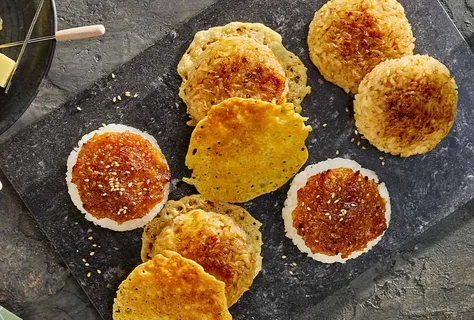
There are many types of onigiri: plain rice, filled, pan-fried or grilled. Some are served crisp, for example with a soy sauce or miso crust, while others stay soft. The shape is often triangular or round.
Classic fillings include umeboshi (sour, salt-pickled plum), konbu (seaweed cooked in soy sauce) and okaka (dried bonito flakes with soy sauce).
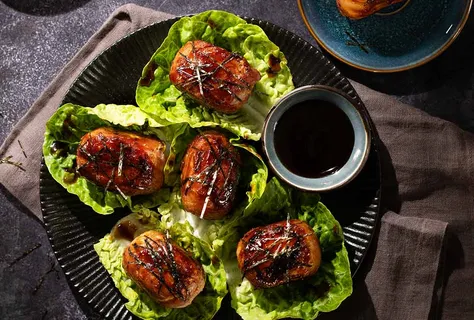
The yaki onigiri version is especially popular. The rice balls are pan-fried or grilled and brushed with Kikkoman Soy Sauce. This creates a wonderfully crisp, golden-brown crust and an unmistakable, savoury aroma—proper Japanese comfort food!
But you don't have to stick to the classic Japanese templates. Be creative! In principle, anything goes: from cheese, kimchi with cream cheese, chicken mayo or bacon to avocado and wasabi, teriyaki tofu, edamame, miso walnut or pickled vegetables such as takana.
Sesame seeds or spring onions are popular as a topping. For the wrapping, you can use nori or strips of omelette. You can also serve the rice balls without any wrapping.